Raichu · Base Set, what to know.
About the Raichu card
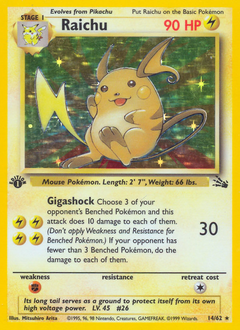
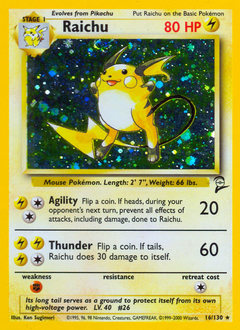
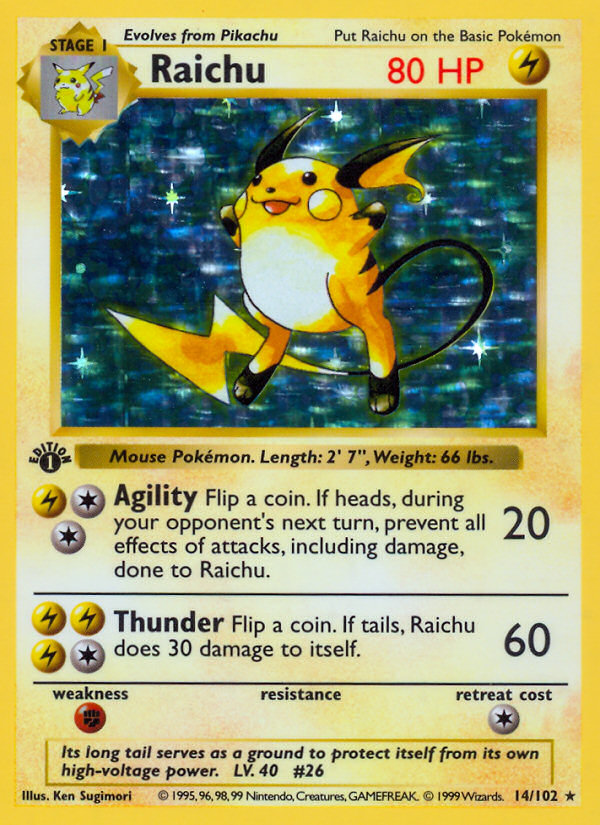
Raichu is card 14 of 102 in Base Set, released in January 1999, a Rare Holo. It is a Stage 1 Lightning-type with 80 HP.
As a Stage 1, it evolves from Pikachu, which places Raichu deeper in its line and means most collectors hold it alongside the cards it evolves from.
Illustrated by Ken Sugimori. Sugimori is the lead character designer of Pokémon itself, so his card art carries the tight, on-model look that defined how the creatures appear in the games.
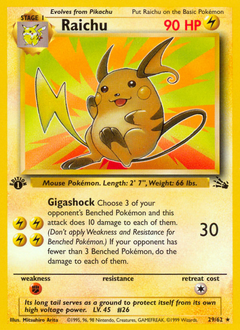
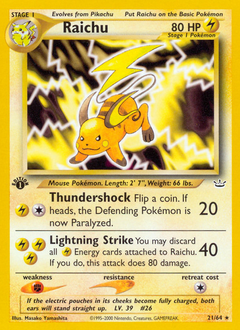
The Pokédex entry printed on Raichu reads: "Its long tail serves as a ground to protect itself from its own high-voltage power."
About Raichu in the Pokémon world
The fully evolved Pikachu. Larger, orange-yellow body, with a long tail. Rare in the wild; usually requires a Thunder Stone evolution. Base Set holo Raichu is one of the famous "where is mine" cards. Its print run had inconsistent centering, and a famously rare prerelease variant exists.
What is Raichu worth?
Based on recent eBay sales, raw copies trade from $32 to $223 depending on the print and a PSA 10 runs from $3,000 to $10,000. The 1st Edition print is the most valuable, with a PSA 10 near $10,000. The table on this page breaks the price down by print and grade, updated 2026-05-21.
Print variants and how to spot them
Base Set produced three print waves that collectors track separately: 1st Edition (the launch print, with an Edition 1 stamp under the artwork), Shadowless (no stamp and no drop shadow on the right of the frame), and Unlimited (the long-running print with the drop shadow restored). On Raichu, the price gap between these prints can run 10x or more, so confirm the variant before any purchase.
Grading and condition
On a holo like Raichu, surface is the grade cap. The lightning foil shows hairlines under raking light, and the print reveals scratches that flat scans miss. Centering on the left and right borders is the second thing to check.
If you are collecting Raichu
If you are buying Raichu, work in order: confirm the print variant first, then the grade, then price against recent sales for that exact variant and grade. For a raw Raichu above a few hundred dollars, insist on angled-light photos of the holo so you can spot hairlines.
Three prints, three markets.
Edition 1 stamp under the artwork. The scarcest and most valuable Raichu print.
No stamp and no drop shadow on the right of the frame. A short transitional print.
Drop shadow restored. The long-running print and the most affordable copy.