Pinsir · Jungle, what to know.
About the Pinsir card
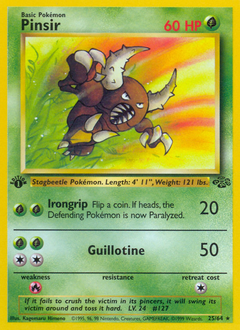
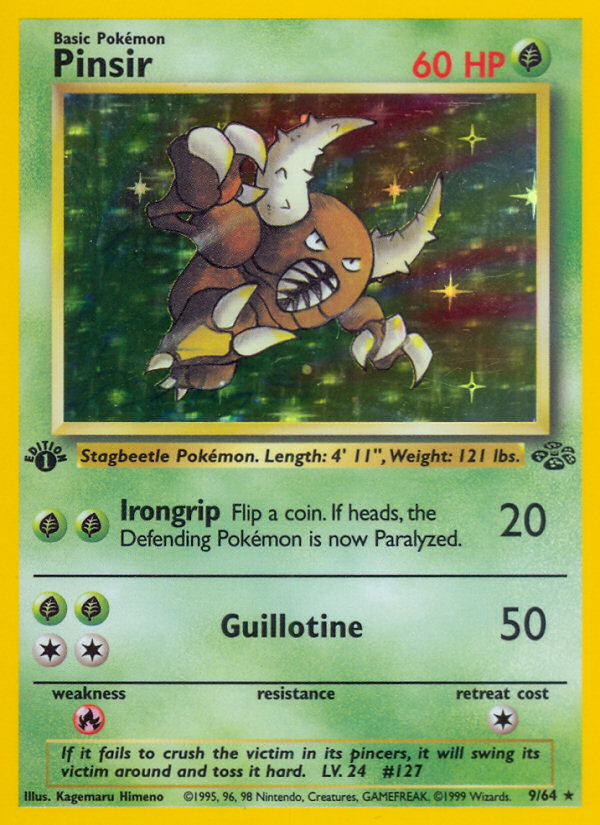
Pinsir is card 9 of 64 in Jungle, released in June 1999, a Rare Holo. It is a Basic Grass-type with 60 HP.
As a Basic Pokémon, Pinsir needs no prior evolution to put into play, which made it a practical card in the era's decks.
Illustrated by Kagemaru Himeno. Himeno is one of the most-recognized vintage illustrators, with a softer, more textured style that shows up across the Jungle and Neo runs.
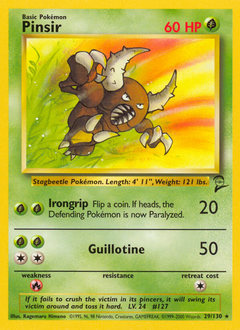
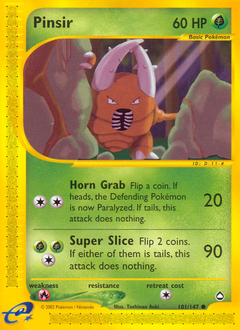
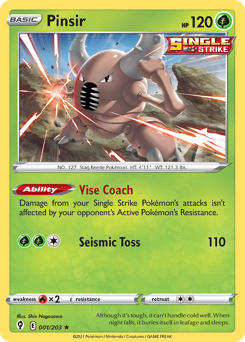
The card's flavor text gives Pinsir a line of lore: "If it fails to crush the victim in its pincers, it will swing its victim around and toss it hard."
About Pinsir in the Pokémon world
A Bug-type stag beetle with prominent pincers. Jungle holo Pinsir is one of the more aggressive-looking Jungle holos and has steady collector demand.
What is Pinsir worth?
Based on recent eBay sales, raw copies trade from $27 to $61 depending on the print and a PSA 10 runs from $1,500 to $7,000. The 1st Edition print is the most valuable, with a PSA 10 near $7,000. The table on this page breaks the price down by print and grade, updated 2026-05-17.
Print variants and how to spot them
Jungle shipped in 1st Edition and Unlimited, with no Shadowless print. The Edition 1 stamp under the artwork separates the scarcer 1st Edition Pinsir from the Unlimited copy. The set also has the famous No Symbol error from its first print run, which adds a premium when the lower-right set symbol is missing.
Grading and condition
Expect the holo window to set the grade on Pinsir. Print misregistration and fine scratches in the grass foil are the usual reasons a copy lands at a 9, and edge whitening against the frame is the next thing a grader notes.
If you are collecting Pinsir
Buying Pinsir well means pricing the exact print and grade, not the card name. The 1st Edition Pinsir trades above the Unlimited copy, so confirm the stamp before you agree a number. Always see the holo surface in good light first.
Three prints, three markets.
Edition 1 stamp under the artwork. Trades above Unlimited in matching grade.
No stamp. The standard, more affordable print.
Early first-run print missing the lower-right set symbol. Carries a premium.